skip to main | skip to sidebar

OPEN SOURCE

Linux for Better life

  • Home
  • Trik-Tips
  • Free Template
  • Blogger Hack
  • Free Ebook
Showing posts with label GAZA. Show all posts

* Print Wedeman: Defiance amid destruction in Gaza

By Ben Wedeman
CNN Senior International Correspondent
Decrease font Decrease font
Enlarge font Enlarge font

Editor's note: The Israeli government is not allowing independent media access through Israel to Gaza. CNN Senior International Correspondent Ben Wedeman crossed into Gaza from Egypt.

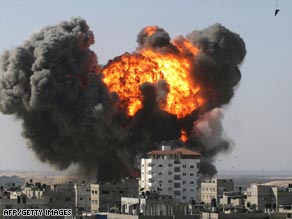
An explosion seen after an Israeli airstrike on Rafah earlier this week.

An explosion seen after an Israeli airstrike on Rafah earlier this week.

RAFAH, Gaza (CNN) -- Bloodshed, fear, privation and anger were all clearly visible in Gaza as we finally managed to enter the territory. Unsurprisingly, there were also displays of fist-shaking defiance, but what I had not expected was the high morale.

We arrived in Gaza in darkness, so at first there was little to see -- but plenty to hear. Israeli planes were passing overhead the whole time, and drones could be heard buzzing through the night.

Then there were the explosions. One impacted not far from where we were staying the night. There was a huge blast. You could feel the shockwave passing through the building, shaking the floors and rattling the windows.

The explosions continued after sunrise throughout the border area. At the Abu Yusuf Al Najjar hospital, the largest medical facility in the border town of Rafah, their horrendous effects were visible. Video Watch Wedeman describe the blasts »

We saw one person who had been riding a bike down the road when a rocket landed nearby. He suffered bone fractures and shrapnel wounds all over his body. His right leg needed to be amputated at the upper thigh.

Doctors, more used to dealing with bullet wounds than the current array of weaponry being used by the Israelis, said 20 percent of the injuries they were dealing with were light, 30 percent were serious to critical, and another 30 percent die within the first 30 minutes of arriving at hospital.

At a U.N. school where people were seeking refuge because their neighborhoods were bombed or under threat, crowds mobbed handouts of blankets and rations. Classrooms in the building were each crammed with six or seven families (all large extended families).

We toured an area near the border with Egypt where tunnels had been dug to get supplies into Gaza. There we saw dozens and dozens of houses completely destroyed, huge craters everywhere.

Earlier, when we caught the last bus from Egypt into Gaza, we spoke to Palestinian passengers, most of whom said they had been arrested in Egypt and abused by police before being deported. Their bitterness toward Egypt, particularly its president, Hosni Mubarak, and other Arab leaders over their perceived failure to provide support was echoed among others we spoke to.

This was matched by anger toward the United States, because most people know it supplies Israel with the warplanes bombarding them.

The attacks have badly affected Gaza's electricity supply. The territory gets its power from Egypt, but lines have been knocked out by explosions, leaving connections intermittent in some areas. Water is also a problem, many areas now without any supply.

With the Israeli offensive effectively cutting the territory in half, there is now no way to pass from southern Gaza to the north, other than in an ambulance -- and even the ambulance drivers say that's not a sure thing.

But despite the problems, there are signs of normality, as many people go about their business in defiance of the conflict. Shops were trading, although only one-fifth were open, and people were on the streets.

I'm surprised at how buoyant people are given the circumstances. Talking to them, I find morale high and an overall sense of defiance.

At one point I saw a young boy on a donkey cart, unaware I was observing him. As an Israeli jet passed overhead, he shook a fist at the


Posted by MALIK 0 comments

Labels: CNN Coverage, GAZA, israel

Israeli forces clash with Hamas gunmen


(CNN) -- Israeli ground forces battling Hamas militants in Gaza struck "at least 20 armed gunmen" Friday, while five civilians were wounded when 15 Palestinian rockets were fired at Israeli communities, the Israeli military said.

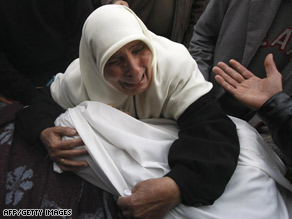
A woman cries as she holds the body of one of her relatives at the mortuary of Al-Shifa hospital on Friday.

A woman cries as she holds the body of one of her relatives at the mortuary of Al-Shifa hospital on Friday.

Click to view previous image
1 of 3
Click to view next image

In all, 25 Hamas sites were attacked in the latest round of fighting, the Israel Defense Forces said.

Israel, which has been working to control weapons-smuggling through tunnels between Gaza and Egypt, also reported that troops "uncovered a tunnel containing weaponry and explosive devices" and the passageway was detonated.

It said troops fired at armed gunmen planting explosives and soldiers shot at an approaching squad of gunmen. The Israeli military gave no estimate on casualties in any of the incidents.

In Israel, Ashdod and Qiryat Gat were among the cities struck by the 15 Palestinian rockets and mortars. One of the five injured was classified as seriously injured. Video Watch latest report from Gaza »

Earlier in the day, Israeli airstrikes rattled northern and southern Gaza as Israeli forces stepped up their campaign against the territory's Hamas leaders.

Streets were deserted after sundown Thursday in Rafah, along the Egyptian border, as Israeli airstrikes shook buildings a kilometer (0.6 miles) from their target. No running water was available Friday, and stocks of food were running low, CNN Senior International Correspondent Ben Wedeman reported from Rafah.

Other bombardments set the United Nations' main relief aid compound on fire and damaged a Red Crescent hospital and a foreign journalists' building.

The Al-Quds Hospital, run by the Palestine Red Crescent Society, was hit twice Thursday -- the second time around 10:30 p.m., leaving the facility in flames and forcing the staff and patients to evacuate onto the streets. The hospital is located in the Tal Al-Hawa neighborhood, west of central Gaza City.

Meanwhile Hamas announced that Israeli forces killed Saeed Siam, one of its leaders, along with his son and brother, and vowed to avenge his death.

Siam served as interior minister in the Hamas-led government before it was dissolved in 2007. Video Watch Saeed Siam's house after attack »

As it stepped up its military campaign, Israel Thursday dispatched senior Defense Ministry official Amos Gilad to Cairo to discuss a cease-fire proposal. Gilad was continuing talks Friday in the Egyptian capital. A Hamas delegation is also in Cairo, talking with leaders there who are trying to hammer out a temporary truce.

Israeli officials have said that it was likely the Jewish state would increase its military incursion in Gaza as movement toward a cease-fire progressed.

advertisement

Israel said it initiated the operation into Gaza -- which is controlled by Hamas -- to stop rocket fire on its southern cities and towns. Thirteen Israelis, including 10 soldiers, have died in the operation in Gaza and from rocket strikes on southern Israel, according to the Israeli military. More than 1,000 Palestinians have been killed, including many civilians, Palestinian medics said.

U.N. Secretary-General Ban Ki-moon is in the region as part of the diplomatic effort to secure a truce. He met with Israeli officials on Thursday, and condemned an Israeli strike that damaged the U.N. Relief and Works Agency's compound in Gaza City that sparked a massive fire and injured three people. Video Watch Israeli response to strike on U.N. compound »


As day broke, residents could be seen returning to their damaged homes to retrieve belongings before fleeing north. Some seemed exhausted, as frequent explosions and the sound of Israeli warplanes overhead made sleep difficult. But others remained defiant. A boy on a donkey cart could be seen shaking his fist as an Israeli jet flew overhead.

Friday's strikes followed the heaviest shelling of the Palestinian territory since Israel launched its military operation nearly three weeks ago.

Israel's push deep into Gaza City triggered heavy battles with Hamas militants, and the third-ranking Hamas leader in the territory died in an Israeli airstrike Thursday, the Islamic militant group reported. Video

Posted by MALIK 0 comments

Labels: GAZA, hamas, israel

Rights group: Israel uses incendiary bombs in Gaza

JERUSALEM – Human Rights Watch said Sunday that Israel's military has fired artillery shells with the incendiary agent white phosphorus into Gaza and a doctor there said the chemical was suspected in the case of 10 burn victims who had skin peeling off their faces and bodies.

Researchers in Israel from the rights group witnessed hours of artillery bombardments that sent trails of burning smoke indicating white phosphorus over the Jebaliya refugee camp in northern Gaza. But they could not confirm injuries on the ground because they have been barred from entering the territory.

The chief doctor at Nasser Hospital in southern Gaza said he treated several victims there with serious burns that might have been caused by phosphorus. He said, however, that he did not have the resources or expertise to say with certainty what caused the injuries.

The substance can cause serious burns if it touches the skin and can spark fires on the ground, the rights group said in a written statement calling on Israel not to use it in crowded areas of Gaza.

Military spokeswoman Maj. Avital Leibovich refused to comment directly on whether Israel was using phosphorus, but said the army was "using its munitions in accordance with international law."

Israel used white phosphorus in its 34-day war with Hezbollah in Lebanon in 2006. The U.S. military in Iraq used the incendiary during a November 2004 operation against insurgents in the city of Fallujah.

An AP photographer and a TV crew based in Gaza visited Nasser Hospital in Khan Younis on Sunday and recorded images of several burn patients.

One of them, Haitham Tahseen, recalled sitting outside his home with his family in the morning when something exploded above them.

"Suddenly, I saw bombs coming with white smoke," said the man, whose burned face was covered with medical cream. "It looked very red and it had white smoke. That's the first time I've seen such a thing."

His cousin, in another hospital bed, was more severely burned, with patches of skin peeling off his face and body, and had to be wrapped with thick white bandages.

The hospital's chief doctor, Youssef Abu Rish, said the burns were not from contact with fire, but he couldn't say what sort of substance caused them. He said information he collected on the Internet indicated it could have been white phosphorus.

White phosphorus is not considered a chemical weapon, and militaries are permitted under laws of warfare to use it in artillery shells, bombs and rockets to create smoke screens to hide troop movements as well as bright bursts in the air to illuminate battlefields at night.

Israel is not party to a convention regulating its use. Under customary laws of war, however, Israel would be expected to take all feasible precautions to minimize the impact of white phosphorus on civilians, Human Rights Watch said.

"What we're saying is the use of white phosphorus in densely populated areas like a refugee camp is showing that the Israelis are not taking all feasible precautions," said Marc Garlasco, a senior military analyst for the rights group. "It's just an unnecessary risk to the civilian population, not only in the potential for wounds but also for burning homes and infrastructure."

Garlasco was among researchers on a ridge about a mile (1.5 kilometers) from the Gaza border who observed the shelling from a 155mm artillery unit on Friday and Saturday.

Some of the burning trails of smoke caused fires on the ground that appeared to go out after a few minutes, said Garlasco, who formerly worked at the Pentagon where he was in charge of recommending high-value targets for airstrikes during the 2003 invasion of Iraq.

By JASON KEYSER, Associated Press Writer Jason Keyser, Associated Press Writer – Sun Jan 11, 9:10 pm ET
Israeli soldiers sit on top of an armored vehicle as smoke rises from Gaza near AP – Israeli soldiers sit on top of an armored vehicle as smoke rises from Gaza near Israel's border with …

Each 155mm shell contains 116 of what Garlasco described as wafers doused in phosphorus that can be spread over an area as large as a sports field, depending on the height at which it detonates. The phosphorus ignites when it comes in contact with oxygen.

Human Rights Watch has not been able to confirm whether there have been any civilian casualties from phosphorus. The group has a consultant working for it inside Gaza but he has been unable to move around due to the danger. Foreign journalists have also been barred from entering Gaza.

Garlasco said photos published Thursday in British newspaper The Times showed Israeli units handling American-manufactured white phosphorus shells with fuses on them.


Posted by MALIK 1 comments

Labels: GAZA, israel, Palestine

Israeli forces advance deep into Gaza urban areas


Palestinian youths inspect the rubble of a mosque and Islamic school after it

GAZA CITY, Gaza Strip – Israeli ground forces made their deepest foray yet Sunday into Gaza's most populated area, with tanks rolling into residential neighborhoods and infantry fighting urban warfare in streets and buildings with Hamas militants who kept up their rocketing of southern Israel.

An Israeli army spokeswoman said residential neighborhoods in Gaza are riddled with homemade bombs and booby traps, including mannequins placed at apartment entrances to simulate militants and rigged to explode if soldiers approach.

The army "is advancing more into urban areas," said the spokeswoman, Maj. Avital Leibovich. "Since the majority of the Hamas militants are pretty much in hiding in those places, mainly urban places, then we operate in those areas."

Early Monday, Israeli navy gunboats fired more than 25 shells at Gaza City, setting fires and shaking office buildings, including the local bureau of The Associated Press. The military said that in general, the targets are Hamas installations but had no immediate information about the shelling that began just after midnight.

Before daybreak Monday, at least one militant was killed in an Israeli airstrike in northern Gaza, where a battle was in progress, hospital officials said.

Gaza medical officials say at least 870 Palestinians, about half of them civilians, have been killed in the conflict that began Dec. 27 with Israeli airstrikes on Hamas buildings, as well as suspected rocket launch sites and smuggling tunnels on the Egyptian border. Thirteen Israelis, including 10 soldiers, have died.

German and British envoys pressed efforts to negotiate an end to the war even though Israel and Hamas have ignored a U.N. Security Council resolution calling for an immediate and durable cease-fire.

Outgoing Prime Minister Ehud Olmert said Israel had made progress in its objectives in the Gaza offensive but was not finished yet.

"Israel is nearing the goals that it set for itself," Olmert said. "However, further patience, determination and effort are necessary in order to achieve those goals in a way that will change the security reality in the south."

While Olmert's comment signaled no immediate end to the offensive, it indicated that Israel is wary of an open-ended conflict with an unclear agenda. Israel wants to end years of rocket attacks by Hamas on its southern population, a complex goal that could require Egyptian or international help in shutting off routes to smuggle weapons into Gaza from Egypt. Israel has been bombing tunnels that run under the Egypt-Gaza border.

In an e-mail message early Monday, Hamas leader Ismail Radwan said his group would not consider a cease-fire before Israel stops its attacks and pulls back from Gaza. He also demanded the opening of all border crossings, emphasizing the Rafah crossing with Egypt.

That would relieve economic pressure on the destitute territory but also strengthen Hamas' control of Gaza, an odious prospect for Israelis who fear a halt to the fighting will just give Hamas another opportunity to re-arm.

Military intelligence chief Amos Yadlin told the Israeli Cabinet Sunday that Hamas' ability to fight has been damaged, the group is suffering from ammunition shortages and has been hard hit by the deaths of senior militants. The military says troops have killed some 300 armed fighters since the ground offensive began and many more were killed in the air phase.

But Yadlin said Hamas "is not expected to raise a white flag."

In Cairo, Egypt's state-owned news agency reported progress in truce talks with Hamas, but provided no specifics. The Middle East News Agency quoted an unnamed Egyptian official as saying talks between the nation's intelligence chief, Omar Suleiman, and Hamas envoys were "positive."

Palestinian medical officials reported about 60 deaths on Sunday, including 17 who had died of wounds suffered on previous days. Most of those killed Sunday were noncombatants, medical officials said, including four members of one family killed when a tank shell hit their home near Gaza City, and a 10-year-old girl killed in a similar attack.

Palestinian witnesses said Israeli troops moved to within half a mile of Gaza City's southern neighborhoods, and within a quarter mile of the northern neighborhood of Sheikh Ajleen.

Firefights in Sheikh Ajleen erupted before dawn as Israeli forces advanced toward Gaza City, home to 400,000 people, Palestinian witnesses said. The battles were still in progress nearly a full day later, though tanks pulled back, with the Israelis in control of some buildings on the neighborhood's outskirts.

"We are safe, but we don't know for how long," said Khamis Alawi, 44, who huddled with his wife and six children in their kitchen overnight. He said bullets riddled his walls and several came in through the windows.

Military analysts say Israeli troops are probing territory, clearing buildings and moving around regularly, rather than digging into positions that would allow Hamas militants to get a fix on their whereabouts and lay ambushes. Israel risks losing the advantage of armor and heavy firepower in urban settings that the militants know well.

Israeli military footage showed soldiers walking around a zoo in the Zeitoun neighborhood of Gaza City two days ago. The footage showed caged birds and a white cable identified as an explosive detonation cord, part of an alleged booby trap set by Hamas.

An Israeli airstrike destroyed a mosque and Islamic school in Rafah, on the border with Egypt. Hours later, men and boys clambered over the wreckage, and one man held aloft the remains of a Quran recovered from the debris.

Israeli has accused Hamas of launching attacks from mosques and schools and using them to hide weapons. Israel says Hamas fighters are wearing civilian clothes and endangering civilians by operating in residential areas.

The Israeli military said it hit more than 40 Hamas militants on Sunday, but did not specify whether they were killed or wounded.

Late Sunday, dense plumes of smoke from explosions rose over Gaza City and heavy gunfire was heard just south of the city.

International aid groups say Israel must do more to ensure the safety of civilians. They note that civilians are in many cases unable to flee to safe places in Gaza, and are essentially trapped because the territory's exits are closed.

The U.N. agency in charge of Palestinian refugees has resumed operations after suspending them because of Israeli attacks on its convoys. U.N. aid vehicles were moving around Gaza on Sunday and U.N. workers tended to about 30,000 people in shelters, but aid officials warned that the dire security situation made it impossible to operate at full capacity.

"This is a very small fraction of what we normally do in the Gaza Strip," said Filippo Grandi of the U.N. Relief and Works Agency. "Things might get worse."

Israel has warned Gaza residents of a wider offensive. On Sunday, it dropped leaflets urging Gaza residents to report the whereabouts of Hamas fighters, providing a phone number to call.

Israel's chief military spokesman, Brig. Gen. Avi Benayahu, said the army has sent more reserve units into the Gaza Strip.

In other fighting, Hamas militants launched at least 24 rockets at southern Israel, lightly injuring three people. Rockets hit an empty kindergarten and a children's playground in the city of Ashdod.

The rockets have disrupted life for hundreds of thousands of terrified people who rush into bunkers and basements at the sound of warning sirens. Four people have died in rocket attacks.

However, thousands of children in southern Israel returned to school Sunday for the first time in two weeks. Schools had been closed since the beginning of the offensive, but the military said schools that have been sufficiently fortified against attack could reopen.

British Mideast envoy Tony Blair and Germany's top diplomat visited Jerusalem Sunday, and Israel planned to send a senior defense official this week to Egypt, which is trying to broker a truce.

Blair met Olmert and said a plan to end the fighting must include a halt to weapons smuggling and the opening of border crossings into Gaza. He said urgency was vital because "every day this action continues there are more people that die."

Germany's foreign minister, Frank-Walter Steinmeier, appeared at a news conference with his Israeli counterpart, Tzipi Livni, in Jerusalem.

"The shooting of Qassam rockets and other weapons must be stopped and the smuggling of new weapons to the Gaza Strip for re-arming, or even to improve the weapons of Hamas, must be stopped," Steinmeier said.

___

Barzak reported from Gaza City and Torchia from Jerusalem. AP reporter Karen Zolka contributed to this report from Jerusalem.


By IBRAHIM BARZAK and CHRISTOPHER TORCHIA, Associated Press Writers Ibrahim Barzak And Christopher Torchia, Associated Press Writers – Sun Jan 11, 9:31 pm ET

Posted by MALIK 0 comments

Labels: GAZA, israel, Palestine

Protesters across Europe call for end to Gaza conflict

(CNN) -- Thousands of demonstrators marched through cities across Europe on Saturday, calling for an immediate end to Israel's attacks on Gaza.

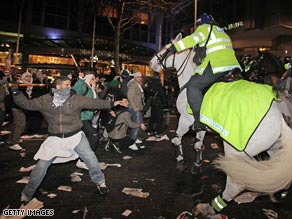
A protester swings a club at a police horse Saturday night near London's Israeli Embassy.

A protester swings a club at a police horse Saturday night near London's Israeli Embassy.

Click to view previous image
1 of 3
Click to view next image
more photos »

Up to 20,000 people were gathered outside the Israeli Embassy in London, England, at the peak of protests there, London Metropolitan Police said.

A police officer was knocked unconscious Saturday night as the protests turned unruly, the police said.

The London crowd dismantled barriers placed in front of the embassy and began pelting officers with sticks, rocks and pieces of the metal barriers, police said. Three people were arrested.

Organizers including the Stop the War Coalition and the Palestine Solidarity Campaign expected more than 100,000 people to join the London march to protest Israel's ongoing attacks on Gaza.

Celebrities including musician Annie Lennox and Bianca Jagger, musician Mick Jagger's ex-wife, spoke at a rally before the procession, which went from Hyde Park to the Israeli Embassy in Kensington, West London. Video Watch demonstrators throw bottles, metal at police »

Lauren Booth, the sister-in-law of former Prime Minister Tony Blair, also spoke at the rally, The Times newspaper reported.

During her speech, Booth criticized Blair over his attempts to bring about a resolution to the conflict.

"Tony Blair's only comment regarding the cease-fire has been to say that it can only take place after the tunnels in Gaza are destroyed," The Times quoted her as saying.

"What he is suggesting means that after the massacre, people will have no access to food, kerosene and medicines that came through those tunnels. That is not a cease-fire; that is a slow agonizing death," she said, according to The Times.

Former London Mayor Ken Livingstone issued a statement backing the demonstration.

"Every day, we see appalling pictures of children slaughtered by Israeli bombs, missiles and other sophisticated weapons," he said. "Yet with more than 700 dead and thousands more seriously wounded, the international community is allowing Israel to continue its completely disproportionate onslaught accompanied by an Orwellian litany of lies."

Meanwhile, the British Press Association reported that similar demonstrations took place in other British cities, including Newcastle and Edinburgh.

Thousands took part in a rally through the center of Edinburgh calling for an end to the military campaign. About 300 shoes and red paint were thrown toward the U.S. consulate in the Scottish capital, the PA said.

Thousands demonstrated in other European cities, according to local media reports, including Innsbruck, Austria; Paris, France; Milan, Italy; Berlin, Germany; and Oslo, Norway. iReport: Protests in Paris

In Washington, pro-Palestinian activists rallied outside the temporary residence of President-elect Barack Obama on Saturday and called on the incoming leader to stop the violence in Gaza.

About 3,000 people carrying signs and chanting "Free Palestine" flooded Lafayette Park between the White House and the Hay-Adams Hotel, where the president-elect is living with his family.

Carrying a flag and wearing a Palestinian keffiyeh head scarf, Abdel-Kader Elkabil exhorted the president-elect to take action.

"Please, Mr. Obama, do something. We love you. We voted for you," he said. "I'm expecting you to do something. ... You're the only one who can do something."

Asma Mobin-Uddin drove to Washington with a group of 500 activists from Ohio. She said she voted for Obama because she believed he could "make a difference."

"President Obama, look in the eyes of your kids and look in the eyes of the kids in that region," she said at the rally. "Please, stop the violence, stop the hate, stop the occupation."

advertisement

Israelis say their Gaza military operation, which started December 27, is targeting rocket-launching sites, Hamas infrastructure and the movement's leaders in an effort to stop militants from sending rockets into southern Israel.

Palestinian medical sources said that more than 800 Palestinians have been killed in the attacks, including 235 children, and about 3,300 people have been wounded. Thirteen Israelis, including 10 soldiers, have died since the operation began.


Posted by MALIK 0 comments

Labels: Europe, GAZA, israel

Israelis, Hamas clash near Gaza City, witnesses say

JERUSALEM (CNN) -- Clashes between Hamas militants and Israeli soldiers raged to the north and east of densely populated Gaza City early Sunday, the 16th day of an Israeli offensive, witnesses and medical sources said.

Heavy gunfire could be heard to the east of Gaza City -- home to about 400,000 of Gaza's 1.5 million people -- as fighting moved closer, according to a CNN stringer in the area.

Israeli shelling north of the city killed two people, sources at Shifa hospital told CNN.

Sunday's fighting came after one girl was killed and 49 other people were severely burned by fires caused by Israeli shelling in southern Gaza on Saturday, local hospital sources said.

The shelling ignited several buildings, including a U.N. school, near the city of Khan Younes, sources said. The girl died of burns she suffered in one of the fires, the sources said.

Also Saturday, a family of nine was killed when a shell hit their home in the village of Jebalya in northern Gaza, Palestinian medical sources said.

The Israeli military was "not operating in the area of this house, and no fire was directed in that direction," a spokesman for the Israel Defense Forces said.

Later Saturday, the IDF said that two rocket-launching squads near Jebalya were hit.

Meanwhile, Hamas militants fired 20 Grad long-range rockets into Israel on Saturday, injuring four civilians, according to an IDF spokesman.

And the Hamas commander in charge of launching rockets into Israel from the Gaza City area was killed Saturday by Israeli ground fire, the IDF said.

Amir Mansi was spotted firing a rocket Saturday from the Jabel Rise area, east of Gaza City, during a ground force operation, the IDF said. Israeli forces opened fire, killing Mansi and wounding two other Hamas operatives, who were captured, the Israelis said. Video Watch what overnight air attacks did »

Mansi was the leading Hamas authority on the Grad long-range missile-launching system, the IDF said. Grad rockets have allowed Hamas to reach farther into Israel than in previous attacks.

Israelis say their Gaza military operation, which started December 27, is aimed at stopping Hamas militants from sending rockets into southern Israel.

The operation began with airstrikes; a week later, the Israeli military launched a ground assault.

More than 800 Palestinians have been killed in the attacks, including 235 children, and about 3,300 people have been wounded, according to Palestinian medical sources. Thirteen Israelis, including 10 soldiers, have died since the operation began. Photo See images from the offensive »

On Saturday evening, two pair of Israeli F-16 fighter jets that were on bombing runs in southern Gaza violated Egyptian airspace, a CNN team observed.

"We can tell they're coming through Egyptian airspace because they're over the far side of the building where we're standing," CNN's Karl Penhaul reported from Rafah, Egypt. He was atop a building about 500 meters (547 yards) from the Gaza border.

The Israelis have been bombing tunnels that run under the border of southern Gaza and Egypt. Israel says Hamas smuggles weapons and munitions through them into Gaza.

A spokesman for the Egyptian prime minister's office said the Israeli aircraft did not have permission to use the airspace. Israeli government spokesman Mark Regev said no airspace violation had occurred.

Before strafing the area in and around Rafah, the Israeli air force dropped leaflets warning residents to leave their homes because more Israeli attacks were imminent, Palestinian security sources said.

According to an IDF spokesman, the leaflets say: "Two days ago, the IDF distributed leaflets in Rafah in which the residents were warned to evacuate their homes for their own safety. As they heeded the IDF instructions, the harming of residents in combat was avoided.

"Over the coming period, the IDF will continue to target tunnels, weapon caches and terrorist operatives with growing intensity. For your safety and that of your family, stay away from terrorist elements or places where weapons are stored or places where terrorist elements operate."

In Gaza City on Saturday afternoon, heavy black smoke rose during a three-hour period during which Israel was to halt its attacks on militants so Palestinians could stock up on supplies.

CNN's Ben Wedeman said the lulls, which have been tried before, aren't "rock solid." Limited military activity continues during that period, he said.

A United Nations spokesman said Saturday's pause was not long enough to resume the transport of humanitarian supplies from Israel into Gaza.

Meanwhile, in Cairo, Egypt, Palestinian Authority President Mahmoud Abbas was meeting with Egyptian President Hosni Mubarak to discuss a possible cease-fire.

Exiled Hamas leader Khaled Mashaal said during a televised news conference Saturday night that his followers will consider any proposals to stop the violence if conditions are met: the Israelis stop their "aggression" and all crossings between Israel and Gaza are opened.

"These are our just demands, and with an open mind we will interact with any initiative," Mashaal said.


Posted by MALIK 0 comments

Labels: GAZA, hamas, israel

In Gaza, truce crumbles as diplomats eye cease-fire talks


JERUSALEM (CNN) -- A truce meant to allow humanitarian aid into war-torn Gaza crumbled minutes after it began Wednesday, while Israeli and Palestinian diplomats considered talks that could lead to a more lasting cease-fire.
The truce was part of Israel's stated desire to open a "humanitarian corridor" into Gaza in response to mounting concerns over shortages of food, water and medicine in the territory since Israeli airstrikes began December 27.

But minutes after the three-hour truce was set to begin at 1 p.m., Israeli forces fired at militants in the Hamas-ruled Palestinian territory.

The strikes came after militants targeted Israeli forces "almost immediately," Israeli Defense Ministry spokesman Peter Lerner said.

Lerner had previously said Israeli forces would respond to any aggression directed at them during the scheduled pause in activities in Gaza.

Hours later, Israel continued its ground and air assault for the twelfth day by bombing targets in Rafah, Gaza, after telling residents to leave.

There were no immediate reports of deaths or injuries from the bombing, which threw up huge plumes of black smoke, visible even in the dark. Video Watch CNN's Karl Penhaul report on the humanitarian situation in Rafah »

Israel has said Hamas, the Palestinian movement that controls Gaza, smuggles weapons from Egypt into Rafah on the Gaza side through underground tunnels. Shutting down that supply route is one goal of Israel's nearly two-week military operation against Hamas. Learn what's behind the conflict »

At least 680 Palestinians have been killed and 3,000 wounded in Gaza since the campaign began on December 27, Palestinian medical officials said. Nearly a third of the deaths and 45 percent of the injuries are women and children, according to the U.N.'s Office for the Coordination of Humanitarian Affairs. Seven Israeli soldiers and three civilians have been killed.

The three-hour truce is scheduled to take place every other day, Lerner said, but humanitarian agencies say the timeframe is not long enough to alleviate the "deepening humanitarian crisis" in Gaza.

"We are feeding 750,000 [people] on a permanent basis," U.N. Relief and Works Agency spokesman Chris Gunness said. "We need to build on this three-hour window; we need to expand that window and let it lead to a permanent cease-fire."

Israel said it welcomes a truce plan by Egypt and France and will continue its discussions with both countries about how to achieve a cease-fire in Gaza, an Israeli government spokesman said. Video Watch CNN's Christiane Amanpour report on diplomatic efforts »

Israel will send two envoys to Cairo, Egypt, in the coming days to discuss a Gaza truce plan, an Israeli foreign ministry official said Wednesday.

The envoys -- Defense Ministry official Amos Gilad and Shalom Turgeman, a political adviser to Israeli Prime Minister Ehud Olmert -- could head to Cairo as early as Thursday, the official said.
It is not clear whether Hamas, the Palestinian movement that governs Gaza, will send representatives to Cairo. Israel refuses to speak directly to Hamas, which it considers a terrorist organization, but it has negotiated with Hamas through Egypt in the past.

Meetings also continued Wednesday at the United Nations regarding a possible cease-fire.

By Wednesday evening, 16 rockets had struck the Jewish state, according to the Israeli military. There was no immediate report of injuries.

Tuesday was the bloodiest day of the Israeli ground offensive to date, when Israeli shelling struck a U.N. school in northern Gaza being used as a shelter by hundreds of civilians. Video Watch officials from U.N. and Israel argue over details of school strike »

The Israeli military said Hamas militants were firing mortars from the school, prompting an artillery strike that killed at least 40 people and wounded dozens more. U.N. officials said there were no militants at the school.

"We are 99.9 percent certain that there were no militants. There were no militant activities in the school or in the school compound," said Gunness of the U.N. Relief and Works Agency.

The Palestine Red Crescent said five ambulances had been hit by Israeli forces, killing six people. The agency did not give a breakdown of paramedics and patients, and CNN was not able to independently verify these allegations.

The Israeli military said it was unaware of any such incidents. Video Watch Arabs react to the conflict in Gaza »

Also Wednesday, Israeli forces allowed a camera crew to cross the Gaza border to shoot footage of the conflict, marking the first time journalists from outside the territory have been let in.
advertisement

The video shows Israeli foot troops on patrol and in a firefight, Israeli tank operations and what Israel said were air troops detonating underground arms stockpiles and Hamas booby traps.

An Israeli army patrol accompanied the BBC camera that shot footage, which was cleared by Israeli military censors. Israel still has not permitted media organizations independent access to Gaza.
g

Posted by MALIK 3 comments

Labels: GAZA, israel

Breaking: UN Says Second School Hit In Gaza


GAZA CITY, Gaza (CNN) — An Israeli missile struck near a U.N. school in northern Gaza on Tuesday, killing several people, Palestinian security and medical sources told CNN.

There are conflicting reports about the details of the strike, which comes after a U.N.-operated school in Gaza City was directly hit by an Israeli airstrike on Monday night, according to United Nations Relief and Works Agency director John Ging.

Ging told CNN that he understood several tank shells landed outside the U.N.-operated school in Jabalya on Tuesday, killing 10 people outside the school and injuring three people inside.

The school was being used as a shelter for civilians fleeing the ongoing Israeli military operation in the Palestinian territory.

Palestinian sources said 44 were killed in the strike, and it was unclear if it was the result of an Israeli airstrike, tank shell, or another missile.

The Israeli military told CNN it is checking the reports.

UNRWA said an elementary school in Gaza City took a direct hit on Monday night from an Israeli airstrike, although the agency said it had told Israel that the school was being used as a shelter. That strike killed three

Palestinian men, all members of the same family, according to the U.N. Relief and Works Agency.

UNRWA said 400 Palestinians were staying in the Asma Elementary school at the time of the Monday night airstrike.

Posted by MALIK 0 comments

Labels: GAZA, hamas, israel, Middle East, United Nations

Israel to open 'humanitarian corridor' for Gaza aid


(CNN) -- Israel has agreed to establish a "humanitarian corridor" to supply residents of Gaza with aid as international concerns about conditions among civilians mount, according to a government statement.
The statement, posted on Prime Minister Ehud Olmert's Web site, said Olmert decided to accept a proposal from security advisers to open the corridor.

It said a path into Gaza, where Israel launched a ground offensive against Hamas militants on Saturday, "will be opened for a specific period of time, during which the population can receive the aid."

The statement also said Olmert spoke Tuesday with U.S. Secretary of State Condoleezza Rice to "update her on political and military developments," including the humanitarian situation.

Hospital workers reported Tuesday that far more civilians than Hamas fighters were arriving at hospitals for treatment.
Food, water, medicine and electricity shortages have been reported throughout Gaza during the campaign, in which nearly 600 Palestinians have been killed and another 2,750 wounded, according to medical sources.

Jerusalem has been under intense international pressure to let goods pass, because of shortage of food, medicines and fuel.
advertisement

"There are food shortages. ... The health system is overwhelmed. The people here don't have electricity," Mohammed El-Halaby, program manager for humanitarian group World Vision, said earlier this week.

El-Halaby said several power lines and water pumps were damaged during last week's airstrikes, which preceded the ground incursion.

Posted by MALIK 0 comments

Labels: GAZA, israel

Gaza: 300 Yards Between Life And Death


RAFAH BORDER CROSSING – Mathematically, it’s not a tricky equation. Politically, though, it’s a complete conundrum. I’m talking about the scenes on the Egyptian side of the Rafah border crossing Sunday.
It was the morning after the start of the Israeli ground assault on Gaza. In the dark, a few hours earlier, I’d been able to make out the sound of Israeli tank tracks grinding through southern Gaza; the whoosh of missiles fired by Apache attack helicopters into targets just a few hundred yards away and the rat-a-tat of assault guns as Hamas and Israeli fighters closed in on one another.

Now, it was light, and around 30 trucks lined up at the Rafah border gates. They were piled high with much needed medical supplies for the teeming hospitals of Gaza and the mounting casualties. The aid had come from Saudi Arabia, Bahrain, Egyptian NGOs and even Scotland. There was even an eight-strong team of Greek trauma surgeons ready to go in and rescue the dying.

It would have been a heartening sight after the madness of the night except for one major detail — the border was closed, the gates firmly shut. That medicine was going nowhere.

And that’s the simple equation. Three checkpoints and 300 yards separated life-giving supplies from the Palestinian wounded and dying. There was fuel in the trucks, drivers at the wheel and politics in the road.

Now the border has been open sporadically over the last few days for a few hours at a time to let aid in and a trickle of wounded Palestinians out (about 120 since the current hostilities began). But Sunday was not one of those days.

The Egyptian border police said they couldn’t let the trucks through because the Palestinian border guards had fled during the night. Israeli tanks and helicopter gunships, I guess, can be expected to have that effect on employees of Gaza’s Hamas government.

The Egyptians also warned it was dangerous and they couldn’t guarantee anybody’s safety. War does tend to be a risky business.

The Egyptian government, meanwhile, has said it can’t fully normalize the border between Egypt and Gaza because that needs an agreement between Hamas and its rivals in the Fatah movement, as well as the presence of European Union monitors.

And as the apologies and public hand-wringing go on, the aid is blocked and the wounded are getting sicker; the dying expiring.

Egyptian President Hosni Mubarak is no friend of Hamas. He did very strongly condemn the Israeli ground assault in a statement Sunday. But on the Egyptian street, especially here close to the border, many Egyptians see that as little more than public bravado.

They criticize him for not sending aid through and for not letting Palestinian refugees come across, at least temporarily. They also point to the fact that two days before Israeli airstrikes began, Mubarak was hosting Israeli foreign minister Tzipi Livni and permitting her to issue threats against Hamas from his couch.

Now clearly I’m not a Middle Eastern expert, but as I mull the chain on the gate at the Rafah crossing, the scale of human need in Gaza seems crystal clear while political red tape is keeping the medicine from the wounded and dying.

Posted by MALIK 0 comments

Labels: CNN Coverage, Egypt, GAZA, hamas, israel, Middle East

Gaza horrors sow seeds for future violence


SDEROT, Israel -- Mohammed Abu Hassanin may be a young boy, but he's old enough to know he's scared of the attacks being launched by Israel in Gaza.
"When the Jews bomb us when we are asleep, [Hassanin] says 'We get scared,' " a translator says.

Hassanin is one boy from Gaza speaking frankly to an anchor on Hamas TV about the attacks, which have gone on for 10 days.

Children like him have accounted for one-third of the casualties at Gaza's main hospital, foreign doctors say. And now Hamas and their media are making them the face of the attacks.

The children have seen terrible images of tragedy: their friends injured or killed and bloodied bodies in the streets.

They are images Hassanin says he will never forget. He'll keep them stored away until he's old enough to do something about it.

"When we will grow up, we will bomb them back," a CNN translator quoted the boy saying on Hamas TV.

It's a sentiment psychiatrists in Gaza say could be responsible a frightening future --­ that the violence children are witnessing will sow the seeds for future violence. Video Watch how Arab media is covering the crisis »

In Gaza, a little girl wails as she talks about her friend who was killed in an attack on a Hamas house.
She could be my sister," the girl tearfully says. "She is my friend but maybe my sister could die some day, I don't know. I am afraid."

Gaza psychiatrist Eyad el Sarraj said similar trauma to children following past Palestinian intifadas has led to violent results. Video Watch psychiatrists explain their fear »

"Today children are experiencing a serious kind of trauma, and I fear for the future," el Sarraj said. "The children of the first intifada were throwing stones at the Israeli troops. And because of the trauma they were subjected to, 10 years later, the same children became suicide bombers."

Nowhere is safe for the children, and many are without food.

On Sunday, Save the Children staff members delivered food parcels to 641 families -- or nearly 6,000 people, including more than 3,000 children -- in Gaza City, east Jabalyah, Beit Lahia, Beit Hanoun and Um Al Nasser. But the group said the continuous air assaults and ground fighting are making movement dangerous for needy families.
"The situation has reached a critical level for children who are exposed to and experiencing violence, fear and uncertainty," said Annie Foster, Save the Children's team leader for the emergency response in the region.

"Parents are facing enormous challenges to protecting and caring for their children. Either they cannot leave their house to attend to basic needs for fear of being caught in the crossfire -- or they are being forced from their homes, into harm's way, to find shelter."

In the streets of Gaza, where Israeli ground forces are operating, and on the Israeli side, where Hamas rockets are being launched, the streets are empty. Even playgrounds for children are equipped with bunkers. Video Watch the latest on Hamas' continued rocket threats »

Sirens wail on the Israeli side warning of Hamas rocket attacks. When asked what they think when they hear the sound, the children respond with only one word: "Fear."

The threat of Hamas rockets in the south of Israel is taken so seriously that almost all the schools within rocket range of Gaza have locked their gates and told children not to come to school. According to the Israeli government, 300,000 students are affected.

The threat to children is something, perhaps the only thing, that people on both sides of the border agree on.

Gaby Schrieber, an Israeli psychiatrist at Barzilai Hospital, says Israeli children get excellent help and structured support ­ -- something he fears children in Gaza won't be receiving.
And if they don't get the support they need or hope for a better future, Schrieber worries what will happen to them.

"Where is hope for them, and how can they structure their future in their minds?" Schrieber said. "They can become extremists."

Posted by MALIK 0 comments

Labels: GAZA, hamas, israel

Al Qaeda message blames Obama, Egypt for Gaza violence


(CNN) -- An audio message reportedly from al Qaeda's deputy chief vows revenge for Israel's air and ground assault on Gaza and calls the Jewish state's actions against Hamas militants "a gift" from U.S. President-elect Barack Obama.
The speaker, identified as Ayman al-Zawahiri, addresses Muslims in Gaza. He said the violence "is one part of a series of a crusade war against Islam and these air strikes are a gift from Obama before he takes office, and (Egyptian President) Hosni Mubarak, that traitor, is the main partner in your siege and killing."

The message, posted Tuesday on various Islamist Web sites with a picture of al-Zawahiri next to an image of a wounded child, urges militants to rally against Israel.

"My Muslim brothers and mujahedeens in Gaza and all over Palestine, with the help of God we are with you in the battle, we will direct our strikes against the crusader Jewish coalition wherever we can."

The 10-minute message also address Muslims worldwide, claiming that Obama was portrayed as "the savior who will come and change American policy" during the U.S. election but is now "killing your brothers and sisters in Gaza without mercy or even pity."

Obama's transition team did not immediately respond to the message. Earlier Tuesday, the president-elect said he was "deeply concerned" about the loss of life in Gaza and Israel, and he promised to make the issue a top priority in his administration.

It was Obama's first public reaction to the ongoing fighting between Israel and Hamas militants in Gaza, which began with Israeli air strikes 11 days ago. He reiterated that only one president can speak for the United States at a time.

"Starting at the beginning of our administration, we are going to engage effectively and consistently to try to resolve the conflicts that exist in the Middle East," Obama said.

CNN Senior International Correspondent Nic Robertson said the al Qaeda message speaks to al-Zawahiri's cause in two ways: It bashes the new U.S. president before he takes office and it criticizes Mubarak, who has drawn al-Zawahiri's ire for not allowing goods and aid through Egypt's border with Gaza.

Al-Zawahiri is a native of Egypt who has served jail time there.

Posted by MALIK 0 comments

Labels: Al-Qaeda, Egypt, GAZA, israel, obama

Telepon Gratis ke Jalur Gaza


Operator menggratiskan panggilan telepon ke jalur Gaza. Namun, nampaknya tawaran menarik ini sia-sia mengingat banyak sarana telekomunikasi yang rusak berat akibat konflik Israel-Palestina.

detikINET kutip dari AustralianIT, Rabu (7/1/2009), Telstra selaku operator terbesar Australia menawarkan panggilan telepon gratis selama seminggu untuk wilayah yang terkena imbas perang tersebut.

Tawaran ini berlaku sejak hari ini hingga 15 Januari mendatang untuk panggilan dengan kode area 0011-970-8.

"Pelanggan Telstra di Australia dapat menelepon kerabatnya di wilayah Gaza secara gratis," ungkap Sol Trujillo, chief executive officer Telstra.

Namun, penawaran yang dibuat Telstra ini dinilai tidak terlalu banyak membawa manfaat, mengingat banyak sarana telekomunikasi di area konflik mengalami kerusakan.

Paltel Group, perusahaan telepon utama di Palestina telah memperingatkan bahwa Gaza dapat terputus dari dunia luar akibat serangan dari darat dan udara.

Menurut Paltel, sekitar 90 persen layanan ponsel Gaza telah lumpuh, dan sejumlah telepon rumah telah rusak.

Selain mengalami kerusakan sarana telekomunikasi, Paltel juga kehilangan beberapa pegawainya yang tewas akibat serangan tersebut.

"Meskipun banyak halangan, kami berusaha semaksimal mungkin untuk tetap menyediakan layanan di jalur Gaza, sekalipun dengan kapasitas yang minim," tandas Paltel.

Posted by MALIK 0 comments

Labels: GAZA, israel, Palestine

Older Posts Home

Links

  • ALJAZEERA TV
  • ANTARA
  • Bali`s Blogger
  • BBC
  • BERITANET.COM
  • CHIP ONLINE
  • CNN
  • DETIK.COM
  • E-BOOK
  • Economic
  • Friends
  • Friendster's Blog
  • Habibieafsyah
  • HARVARD UNIVERSITY
  • ILMU KOMPUTER
  • INFO LINUX
  • KICK ANDY
  • LINUX OpenSuse
  • LINUX SLAX
  • Linux Temanggung
  • LINUX UBUNTU
  • LIPUTAN 6 SCTV
  • MASTER BLOGGER
  • METROTV NEWS
  • MUSIC DOWNLOAD
  • My Class
  • Robotic AMIKOM
  • SMA N 3 TEMANGGUNG
  • SMART E-LEARNING
  • SOFTPEDIA
  • STMIK AMIKOM
  • SUPPORTED BLOGGER
  • TIPS TRICKS
  • TRIAL FILM
  • TV ONE ONLINE

Blog Archive

  • ▼ 2009 (38)
    • ▼ 05/31 - 06/07 (1)
      • Java
    • ► 02/15 - 02/22 (1)
    • ► 01/11 - 01/18 (11)
    • ► 01/04 - 01/11 (25)
  • ► 2008 (70)
    • ► 11/30 - 12/07 (22)
    • ► 11/16 - 11/23 (18)
    • ► 11/09 - 11/16 (1)
    • ► 10/26 - 11/02 (5)
    • ► 10/19 - 10/26 (16)
    • ► 10/12 - 10/19 (4)
    • ► 10/05 - 10/12 (4)


$100.00 Anda pasti untung setelah registrasi!


Search Engine Optimization and SEO Tools


Bookmark CO.CC:Free Domain